Wednesday, May 1, 2024

Vox Puts Today's College-Campus Protests in Historical Context

Vox.com has an article putting today's college-campus protests over Gaza, Israel, and the Palestinians in the context of US campus protests of the past 60 years, including those over Civil Rights, South African apartheid, and the Vietnam War. The article's interviews with researchers of student activism suggest that some things we are seeing currently are similar to what happened in earlier decades, whereas some present developments are not.

It is the Vox article's life-stage explanation of protest activism -- along with the importance of social context -- that most directly resonates with emerging-adulthood research. Consider the following passages from the article:

There is something about a university campus that inspires political activism. Even in the age of social media, geographic proximity to a community with a high concentration of young people — many of whom are thinking critically about the world for the first time and may be undistracted by the pressures of adult life — seems to help incubate social movements. 

“The university is the center of teaching and learning where people are taught in classes, or out of classes, to question things,” [New York University professor Robert] Cohen said. 

This isn’t specific to America. All around the world, college campuses are hubs of political activity and young people are at the forefront of social movements.

If these topics interest you, the above-linked Vox article is definitely worth a read.

Friday, June 9, 2023

Book Review: After the Ivory Tower Falls

Higher education -- whether one goes to college or not -- affects the lives of millions of Americans in the emerging-adult age-range, and not necessarily for the better. So says Philadelphia Inquirer columnist Will Bunch in his 2022 book After the Ivory Tower Falls: How College Broke the American Dream and Blew Up Our Politics -- And How to Fix It.

With the possible exception of youth whose parents are willing and able to pay annual costs approaching, in some cases, $75,000 for tuition, room, and board, college leaves no one unscathed, in Bunch's view. Those who attend are left with huge debts, no degree if their funds run out, and possibly no job opportunities related to their field of study. Through these processes, tremendous inequality has been "locked in" (p. 7). Meanwhile, some of those who do not (or did not) attend feel that they are looked down upon by their more educated counterparts, fueling resentments among the non-college-educated that have manifested themselves in the political arena.

Further, Bunch links massive student debt -- $1.7 trillion in the aggregate -- to altering the trajectories many lives may otherwise have taken during emerging adulthood:

This millstone forced millions of Americans under thirty-five to live with their parents or in cramped apartments -- using the money that in the past would have gone toward a mortgage to instead pay off their never-shrinking loan balance -- and postpone getting married and starting a family (p. 133).

Bunch identifies multiple sources for the problems besetting modern higher education. The original sin, in his view, is the failure during the post-World War II era to follow through in expanding the GI Bill -- which provided financial assistance for returning veterans to attend college -- so that higher education would become a government-funded "public good" for all Americans, the way public K-12 education is. Further, even in parts of the US in which a public-good ethos toward higher education did take hold, most notably California, the 1966 election of Ronald Reagan as governor and his antipathy toward student demonstrators led to escalating tuition and fees at University of California (UC) campuses. The cutting of state appropriations to higher education in more recent decades has exacerbated the problem of college costs, Bunch contends.

Embedded within the education wars is a question of human development and emerging adulthood: Is the aim of higher education job preparation, general intellectual and personal growth, some of both, or different emphases for different students? As Bunch reports, Reagan in 1967 came out forcefully in favor of "workforce development" (p. 88), an idea that would spread throughout the US in the following years. General learning to become a more well-rounded person would be diminished and (whether causally related or not) many more students began majoring in business (p. 97). In recent weeks, in fact, one prominent governor derided "niche subjects" while promoting more "employable" fields of study. 

Bunch's historical overview of developments during the GI Bill and Reagan/UC eras are first-rate, in my view. These areas are well-researched and compellingly reported, as one would expect from a Pulitzer Prize-winning journalist such as Bunch. Throughout the book, his extensive interviews with students, graduates, dropouts, administrators, political activists, and others bring life to the statistics.

The book contains some other ideas that scholars of emerging adulthood might be interested in pursuing:

  • Bunch talks of college helping to create, during the 1950s and '60s, an "extended adolescence," a respite from farming and industrial work, and a "youth culture" (p. 61), ideas previously discussed by Erikson, Arnett, and others.
  • Related to identity formation, Bunch cites political scientist Lilliana Mason's notion of "mega-identities" (p. 106), in which different potential dimensions of identity -- e.g., politics, religion, gender roles -- become mutually reinforcing, melded, and aligned with each other. These mega-identities can then help polarize people's attitudes in support of or in opposition to college education and associated cultural connections (e.g., radical professors, student demonstrators). 
  • Many readers are probably familiar with the term "deaths of despair," coined by economists Anne Case and Angus Deaton to describe burgeoning rates of suicide and substance abuse/overdose fatalities among middle-age, non-college-educated, working-class White residents of Rust Belt and Appalachian regions of the US. Having covered the tragic stories of some young adults who died in a similar manner and seeing some newer data on youth fatalities, Bunch also notes that deaths of despair appear to be "surging for younger people without college diplomas" (p. 185). A Google Scholar search of "emerging adulthood" and "deaths of despair" yields very little at this point, so research opportunities in this area seem fertile.

In the final parts of the book, Bunch offers recommendations for ameliorating the destructive aspects of college financing and improving young adults' overall personal development. These recommendations center around universal free higher education (either college or other forms of training such as career and technical education), coupled with mandatory national service (either military or civilian). The latter would not only produce tangible benefits to society but could also help unify our fragmented country.

Saturday, December 3, 2022

US Census Report on Young Adults' Homeownership, 2000-2019

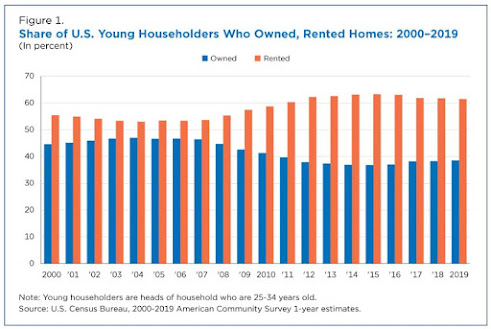
The US Census Bureau issued a report roughly two weeks ago on trends in 25-34 year-olds' homeownership between 2000-2019 (link). The report notes that, "The impact on the housing market of the COVID-19 pandemic, which began in 2020, is not captured in this dataset." Even before COVID, however, the trend was not favorable and it is hard to imagine how young adults' rate of homeownership could have gotten better during the pandemic.*

The data we do have show that young adults' homeownership rose slightly and then stabilized between 2000 and 2007. The Great Recession (a large element of which involved reckless and even fraudulent conduct connected to home loans) then clobbered young-adult homeowners (existing and prospective). The percentage of young-adult heads of household who owned their homes (as opposed to renting), which had been in the mid-40 percent range as of 2007, declined to the mid-30 percent range as of 2015. As of 2019, this rate had inched up only to the high 30s. Naturally, as homeownership began to decline, renting began to rise. Here's a screenshot from the report...
The report next discussed young adults' homeownership in relation to education (Figure 2, not reproduced here). Interestingly, in the very early 2000s, young adults whose highest educational attainment was a bachelor's degree (or higher), some college, and a high school diploma all owned homes at similar rates (mid-high 40s), with those having less than a high school diploma lagging. By 2019, however, appreciable gaps in homeownership had opened up between educational categories (bachelor's-plus clearly exceeding some college, some college clearly exceeding high school graduates, etc.).

Lastly, the Census report discussed racial-ethnic differences in homeownership. Looking only at 25-34 year-olds with a bachelor's degree or higher (to hold education constant, permitting a more direct focus on race-ethnicity), we see that racial disparities still exist. As of 2019, approximately 50% of young adults who were White (either Whites overall or more specifically non-Hispanic Whites) owned their own home. Hispanic/Latinx, Asian, and other-race young adults were in the mid 30s, whereas African Americans were in the mid 20s. Remember, the educational status of all these groups was held constant.

I suspect that these disparities represent some combination of racial-ethnic discrimination (in hiring, so that minorities make less income, and in lending) and White parents having more money, on average, to help their grown children out with a down payment.

One issue I would like to see addressed within the US context is where young adults are living or trying to live. Large cities such as New York, Boston, Washington DC, Chicago, Los Angeles, and San Francisco, along with "hot" up-and-coming markets such as Austin and Nashville, have become expensive for everyone, but especially young adults. Other places such as Lubbock, Texas, and West Lafayette, Indiana, are not as expensive. Will young adults continue to gravitate to large cities -- where multiple roommates are often required even to live in an apartment -- or might there be an increase in young adults seeking out smaller towns?**

---

*In fact, there has been a lower rate of independent living for young adults during COVID. According to a report from the Pew Research Center, a few months into the pandemic (July 2020), the "share of 18- to 29-year-olds living with their parents [had] become a majority..., surpassing the previous peak during the Great Depression era." Others have pointed out that the percentage of grown children living with their parents returned to more typical levels as COVID restrictions eased. However, the financial, educational, housing, and other forms of disruption during COVID would not seem conducive to young-adult homeownership in the near future. 

**As an aside, one of my favorite neighborhoods in the whole country is Wrigleyville, by the Chicago Cubs' baseball stadium Wrigley Field. I wrote a chapter about the neighborhood in the Society for American Baseball Research book Wrigley Field: The Friendly Confines at Clark and Addison (G. H. Wolf, editor). In it, I noted that despite "Wrigleyville housing [costing] 2.2 times as much as the Chicago average," 20-29 year-olds comprise 31.5% of residents within the ZIP code containing Wrigley Field (the third-highest percentage of young adults within any Chicago ZIP code). 

Tuesday, September 6, 2022

New Historical Marriage Figures from US Census Bureau

The US Census Bureau released a report a few days ago, providing extensive marriage statistics on individuals born from 1940-1994 (link). Someone born in 1940 would be 82 today, whereas someone born in 1994 would be 28. The data are grouped into five-year birth bunches (1940-1944, 1945-1949, etc.). 

As shown in the following screen capture (on which I've literally connected the dots in yellow highlighter for ease of viewing), the percentage of people married by age 25 has plummeted during the years studied. As highlighted in the lower yellow line, 80% of women born between 1940-1944 were married by age 25. By the time we get to the 1990-1994 birth-cohort, however, only 30% were married by 25. That's a huge change! Men's trend for marrying by 25 (bottom set of dots) parallels women's, although is lower in absolute level. Roughly 65% of men born from 1940-1944 married by age 25, a figure that has dropped to 20% in men born from 1990-1994. 

Note that the trendlines for men and women being marrying by age 35 (top yellow line) also declined from 1940-1944 onward, but much more gradually than did the marriage-by-25 trendlines.* What this is saying is that, even for the younger cohorts, marriage by 35 is quite common (around 70%).

The report also contains statistics on the rate of being married once vs. multiple times. Click on the above-linked article if you're interested.

---

*You may have noticed that there are no married-by-35 data-points for the two youngest birth-cohorts (1985-1989 and 1990-1994). The reason is that nobody born from 1990-1994 has yet reached age 35, whereas only some in the 1985-1989 cohort have. Hence, the percent in these cohorts who have married by age 35 won't be known for a few more years.

Thursday, August 25, 2022

New National Findings on US 19-30 Year-Olds' Substance Use

Earlier this week, results came out from one of the major US substance-use surveys, namely the annual Monitoring the Future project conducted by the University of Michigan. The headline of UM's news release was "Marijuana, hallucinogen use at all-time high* among young adults." However, I think some of the alcohol-related findings are also quite interesting. 

Regarding past-year marijuana use (i.e., any use of marijuana in the past year), 30.8% of 19-30 year-olds in the year 1988 had smoked some pot in the past 12 months. This figure dipped into the low-20% range during much of the 1990s, rose slightly into the mid-high 20% range in the 2000s, rose through the 30% range in the 2010s, and reached 42.6% as of 2021 (see Figure 1 of full report).    

Past-year hallucinogen use had a roughly 3%-4% prevalence among 19-30 year-olds consistently from 1988-2017 (Figure 20 of full report). The figure rose to around 5% in 2018 and 2019, before escalating to 7.6% in 2020 and 8.1% in '21. Some of the survey's methodology was changed during COVID-19. One can also envision how stay-at-home orders -- and the potential accompanying boredom -- might have affected substance use. However, any direct linkage between COVID-related factors and recent substance-use increases does not appear to have been established at this time.

One set of analyses compares current full-time college students to same-age noncollege peers (i.e., within four years post-high school) in their substance-use patterns. Results are also broken down by gender, yielding four groups: male college students, male noncollege individuals, female college students, and female noncollege individuals. As shown in the full report, past-year alcohol consumption was most common among college women (77.5% engaging in the behavior), followed by college men (73.4%), noncollege women (71.9%), and noncollege men (65.3%) (see Table 27). 

On a measure of heavier alcohol consumption -- number of occasions within the previous two weeks consuming five or more drinks -- the group with the highest rate was college men (33.9%), followed by college women (28.8%), noncollege women (24.7%), and noncollege men (23.3%) (Table 29). Hence, college continues to be a social context conducive to heavy drinking and differences between young men and women continue to shrink.

---

*Whether the pun of juxtaposing "marijuana" and "high" was intentional or unintentional, I don't know.

Friday, July 29, 2022

My New Textbook on Emerging Adulthood

My new textbook Journeys through Emerging Adulthood has now been published. A free preview of Chapter 1 is available via Amazon and the book's publisher, Routledge/Taylor & Francis. The book is the culmination of my 20+ years of doing research on emerging adulthood and 14 years of teaching the course Development in Young Adulthood at Texas Tech University. It was a labor of love to write.

I'm happy to discuss possible adoptions with anyone. Some university departments of human development and family sciences offer courses on young adulthood or one could offer a special-topics course in psychology or sociology. Twenty-somethings and parents of twenty-somethings may also enjoy the book. 

Wednesday, July 27, 2022

Young-Adult Voters' Attitudes Toward President Biden Roughly Three Months Before 2022 Midterm Elections

Five-Thirty-Eight has a piece today examining the low percentage (slightly below 40%) of 18-29 year-old Americans who approve of the job President Joe Biden is doing. This approval rate is not that different from that of Americans as a whole; however, considering young voters' overwhelming support of Biden in the 2020 election, their diminished approval is highly notable. The article explores many possible reasons for Biden's dip among young adults, but one in particular meshes with the study of emerging adulthood.

Extensive research on laypersons' criteria for considering someone an adult shows one of the three primary standards to be whether the person has achieved financial independence. The Five-Thirty-Eight article notes that those transitioning to adulthood indeed hold themselves to this standard ("35 percent of Americans age 15 to 25 said financial independence was their most or second-most important life aspiration, ahead of other priorities such as having a fulfilling career or being married"). The uneven economic performance under Biden -- low unemployment but high inflation -- is thus likely dragging down approval for the President.

Emerging-adulthood scholars also are interested in young adults' election turnout -- traditionally low but strong in the last midterm election year of 2018. There are, of course, questions of whether low enthusiasm for Biden will affect 18-29 year-olds' turnout to vote this upcoming November. The Five-Thirty-Eight piece quotes John Della Volpe, a pollster specializing in young voters, to the effect that "Despite the frustration that young people have about government in general, they just feel more connected to voting.” 

Personally, I'll need more evidence in the coming years to proclaim young adults "connected to voting." But if they do turn out heavily this November despite their current low enthusiasm for President Biden, it will be noteworthy.

Saturday, August 22, 2020

College Students Return to Campuses, But Even Amidst COVID-19 Continue to Socialize

As I noted in my previous entry, "teens and young adults like to socialize, pure and simple." Nowhere is this more clear than at those U.S. universities whose administrators have opted to bring students back to campus for in-person instruction of some form. 

Inside the classroom, the combination of instructors' ability to monitor students' mask-wearing, the spacing of available seats, and potential peer pressure to conform from students who do not want their classes to be disrupted by mask-refuser holdouts, makes me think safety measures will largely succeed.  

The greater threat of Coronavirus spreading, as has begun to be borne out in the last week or so, is students' socializing and partying outside the classroom. Today's New York Times has an article entitled "Stop Campus Partying to Slow the Virus? Colleges Try but Often Fail" (link). After describing some of the  campuses at which clusters of new COVID-19 cases have recently emerged, the article discusses the myriad responses administrators have tried, in an effort to contain the spread.

These responses include no-party mandates, student codes and pledges, monitoring by residence-hall advisors, punitive sanctions (suspensions from school and evictions from dormitories), encouragement of students to inform on each other's safety non-compliance, shaming messages ("Do you want to be the person responsible for sending everyone home?"), and "We're in this together" advertising campaigns. The sheer breadth of these measures suggests no one method has been overwhelmingly successful.

As a result of new COVID-19 outbreaks at some universities, some are indeed sending students back home for online-only instruction (e.g., University of North Carolina-Chapel Hill), whereas others have told students who were scheduled to return to campus not to bother after all (e.g., Michigan State). The schools reversing or delaying their returns to on-campus instruction currently number in the hundreds, according to the website Inside Higher Ed.

Unless there is a major sea change in students' willingness to refrain from socializing -- which is not entirely students' fault, in my view, given universities' mixed messaging in continuing to stage entertainment-type events such as football games with tens of thousands of spectators in attendance -- I see the present trends toward greater spread and shifts to off-campus learning continuing.

Tuesday, July 7, 2020

COVID-19 Rise in Young Adults

Click on graph to enlarge.

The graph above -- from South Carolina's Department of Health and Environmental Control (DHEC), showing the state's COVID-19 cases per 100,000 population by age group from March 7 to June 20 -- documents a trend we're hearing a lot about. A lot of cases during the recent wave are among young adults.*

According to the above-linked DHEC report, "Since April 4, data from the agency shows that there has been a 413.9% increase in newly reported COVID-19 cases among the 21-30 age group..."

A Vox piece notes that, "Young people, who account for a bigger share of the recent cases, aren’t at nearly as high a risk of dying from the virus, but some small number of them will still die and a larger number will end up in the hospital." Even if young adults' fatality rate is low overall, however, yet another manifestation of societal health disparities is a finding that "Black people with COVID-19 in the 25-34 age group had a mortality rate 7.3 times that of non-Hispanic white people." Hispanic-to-white mortality ratios are only slightly less pronounced.

Why the surging COVID count among those in the emerging adulthood range? Three partially overlapping theories seem to be getting the most attention.
  • Relative to their older counterparts, on average, adolescents and young adults are thought to see themselves as more immune to certain dangers, earning them the nickname "Young Invincibles." Research has indeed shown greater sense of invulnerability to correlate with some risky behaviors.
  • The brain's prefrontal cortex (PFC), which is associated with reason, planning, and blocking impulsive acts, does not appear to mature fully until well into one's twenties. Hence, lack of a fully developed PFC among many in the emerging-adulthood age-range -- combined with a brain-based attunement to rewards such as opportunities to socialize -- may leave them susceptible to risky behaviors. Interestingly, one study that briefly disrupted people's PFC found an increase in gambling.
  • Related to the previous two ideas, teens and young adults like to socialize, pure and simple. In Minnesota, four bars have been identified as COVID "hot spots" for young adults. One of these bars is in the Dinkytown district by the University of Minnesota-Twin Cities, another is not too far away in downtown Minneapolis, and two are in Mankato, home to a Minnesota State University campus. College-area bars have also been linked to COVID in other states, as well.

How do young adults, themselves, view the situation?

The Huffington Post recently teamed up with the polling organization YouGov to survey U.S. adults of all ages on their behaviors and attitudes regarding COVID. A key item (shown in the following graph) concerns respondents' self-reported mask-wearing in public, near other people. Indeed, fewer respondents under 30 years old (40%) reported "always" wearing a mask than was the case in any of the other age groups.


If one goes to the HuffPost article at the above link, one can plot the data by any combination of variables one wishes to see (atop the graph, the little "v" in the right-hand part of the green area can be used to select survey items, whereas the "By" button on the little blue square can be used to select the grouping variable, such as age). 

One of the attitude items asked respondents if they believed wearing a mask was more a matter of public health or of personal choice. Interestingly, in each of the four age groups (under 30, 30-44, 45-64, and 65+), far more people cited public health (roughly 60%) than personal choice (roughly 30%). Young adults, therefore, are seemingly on the same page attitudinally with their older peers, but they simply don't follow through in wearing masks.

As this latest COVID surge unfolds, stronger government orders to wear masks are coming out -- even in previously resistant states such as Texas -- so we'll see if this does anything to change the behavior of young adults.

---

*Although some of the increase in case numbers may stem from increased testing, that is clearly not the only reason. As this article points out, "more people in lower-risk populations are likely being tested now than when tests were being strictly rationed to severe cases," which should lead to lower test-positivity rates. Yet, in many regions of the U.S., positivity rates are up. Also, the rising hospitalizations seen in many locations presumably originate from people who feel really sick with COVID-type symptoms going -- or being taken by family or friends -- to their doctor or an ER, which has little or nothing to do with testing campaigns in the community.

Thursday, March 21, 2019

Pew Report Compares Millenials to Earlier Generations

The Pew Research Center, a little over a month ago, released a report entitled "Millennial Life: How Young Adulthood Today Compares with Prior Generations" (LINK). The report defines Millennials as those born from 1981-1996, making them 22-37 at the time of the analyses (2018). The researchers then compared Millennials to members of three prior generations (X, Baby Boom, and Silent) when members of those generations were likewise 22-37.*

Millennials are more educated and less likely to be married than their earlier-generation counterparts. The report also looks at employment, earnings, living with one's parents, and voting. One of the more interesting graphs, in my view, shows that whereas marriage rates within each pre-Millennial generation did not vary much by education (e.g., in the Silent Generation, subgroups with different educational attainment all fell within 81-86% being married), there were wide educational differences in marriage among the Millennials. Fifty-three percent of Millenials with a Bachelor's degree or higher were married, compared to 44% of those with some college and 40% of high school graduates.

This report is a must-read for those interested in the demographic characteristics of today's young adults.

---
*Some of the analyses compared 25-37 year-olds, presumably as a result of different data sets having responses from different age groups available.


Thursday, May 17, 2018

Politico Series on Cities with Large Populations of Millennials

The Washington, DC-based Politico magazine recently had an article on cities for Millennials (which the article defined as those born from 1981-1997). To identify these cities, the authors devised a formula that rated cities on factors such as the share of adults in a city who are 25-34, percent of 25-34 year-olds with college degrees, and issues related to cities' economic growth and suitability to walking and using public transportation, the latter "a well documented preference among millennials."

The result is this list of millennial-aligned cities. Note, however, that many of these cities have features that are not necessarily millennial-friendly, such as sky-high rental and housing costs (e.g., San Francisco, Boston, Washington, DC, and Seattle). On the page with the list, you should see a small circle in the lower-right of the screen, by which it says "TOGGLE." Clicking on the circle will bring up a set of demographic features, with which you can tailor a set of characteristics to your liking, by sliding the bars for more or less of a certain feature. When you do this, the city rankings will automatically be recalculated to fit your needs.

The article notes that, "the cities that millennials are adopting and transforming tend to be as racially and ethnically diverse as millennials themselves. Two-thirds of the top 50 cities are majority-minority..." Two central features of Emerging Adulthood are exploration and new experiences. Diverse cities will allow young adults to meet people with different backgrounds. To the extent the local job-market is strong, these young adults can also explore different possible lines of work. However, if someone moves to a totally new city, the one safety-net that makes a lot of this exploration possible -- the parental home to which one can boomerang -- won't be there.

Monday, September 25, 2017

NY Times Marriage Article Alludes to Emerging-Adulthood Themes

Today's New York Times article, "How Did Marriage Become a Mark of Privilege?", while focusing on marriage-rate differences by socioeconomic class, also incorporates discussion of the transition to adulthood. A couple of key paragraphs from the article are as follows:

Americans across the income spectrum still highly value marriage, sociologists have found. But while it used to be a marker of adulthood, now it is something more wait to do until the other pieces of adulthood are in place — especially financial stability. For people with less education and lower earnings, that might never happen. 

College graduates are more likely to plot their lives methodically — vetting people they date until they’re sure they want to move in with them, and using birth control to delay childbirth until their careers are underway.

Indeed, as Jeff Arnett showed in a 2001 Journal of Adult Development article, only around 13% of midwestern U.S. respondents considered getting married as something that was necessary for adulthood (this figure did not differ much by respondent age). The other portions of the description, about planning and vetting, fit a standard description of emerging adulthood.

Like marriage, emerging adulthood is also linked to SES. As Katherine Newman (2012) notes in her book The Accordion Family, the better-off a family, the more capable it is of supporting emerging-adult pursuits such as unpaid internships. Some of the ideas given in the Times article for facilitating marriage among those less well-off, such as affordable housing for young adults, would also likely provide a stable base for emerging-adulthood-type exploration in the areas of work and romantic relationships.

Thursday, April 13, 2017

Chicago School System Aims to Expedite Graduates' Career Planning

According to this Vox article:

Chicago Public Schools has a new requirement for its 435,000 students: To graduate, they must prove they have a post-graduation plan. That means a college acceptance letter, a job offer, military orders, or enrollment in a job training program.

In many observers' view, emerging adulthood best serves as a time of intentional exploration, in which individuals contemplate and try out different educational and career pathways, en route to finding ones that embody their "true selves." This period of life, however, can also involve what some would consider unproductive use of time (e.g., heavy drinking, excessive media usage) and floundering.

Chicago's plan can be seen as an attempt to direct more students toward a purposeful trajectory. Vox quotes an important point from city school official Janice Jackson: “In schools with high levels of support, every child was already walking out with a postsecondary plan... There are schools where we need to push a little bit more.”

College attendance is not simply a matter of skills and motivation. Financial considerations and what many teens consider an intimidating process of applying to college and for financial aid, also can determine whether a student ends up at a university. Chicago is seeking to combine its new graduation requirement with extra counselors and other resources to help students find their way.

Thursday, February 9, 2017

Detailed Analyses of Rent Assistance Emerging Adults Receive From Parents

The New York Times's "Upshot" quantitative analysis crew delves into the amount of rent assistance individuals in their early 20s receive from their parents. The article includes comparisons by where the grown children are living and the type of career they are pursuing.

Naturally, parents give more assistance when their children are living in big cities. Also, "Those in the art and design fields get the most help, an average of $3,600 a year... [Whereas] some jobs in science, technology, engineering, management and law have clearer and more substantial payoffs after years of internships and postgraduate training, ... pay in art, design and education is low in the early years, and for some people, it remains low."

These findings remind me a little of Richard Florida's ideas regarding cities as magnets for individuals in the "creative class."

Wednesday, May 25, 2016

Living with Parents Now Most Common Status for 18-34 Year-Olds

The Pew Research Center has just released a report, announcing that "In 2014, for the first time in more than 130 years, adults ages 18 to 34 were slightly more likely to be living in their parents’ home than they were to be living with a spouse or partner in their own household" (link). When social scientists analyze large data sets -- in this case, several rounds of the once-a-decade U.S. Census plus recent versions of the American Community Survey -- it can take a few years for all the data to be processed and analyzed.

The 2014 breakdown of young adults' living arrangements, according to Pew, were as follows:

  • 32.1% living with parents
  • 31.6% living with spouse/partner
  • 22% living in miscellaneous arrangements, such as with grandparents, siblings, or in a college dormitory
  • 14% living alone (or as a single parent) or with roommates.

The overall trend is largely driven by men. By a margin of 35-28%, men in 2014 were more likely to live with parents than with a spouse/partner. In women, living in a marital/cohabiting relationship still exceeded residing with parents (35-29%).

Also, college-educated individuals are an exception to the trend. Young adults with a bachelor's degree were far more likely to be married or cohabiting (46%) than living with parents (19%). The 46% of college grads married or cohabiting in 2014, however, is a come-down from previous decades; in 1960, approximately 70% of college grads were married or cohabiting (mostly married, in all probability).

(Thanks to AZ for originally posting the link on Facebook.)

Saturday, May 14, 2016

Prof's Tips for College Students Raise Emerging Adulthood Themes

Columbia University professor Christopher Blattman has just published a piece entitled "10 things not enough kids know before going to college" (link). In my estimation, four of Blattman's tips involve themes associated with emerging adulthood.

Three pieces of advice -- No. 1 "Try careers on for size," No. 7 "Go to places that are unfamiliar to you," and No. 10 "Blow your mind" (challenging your own beliefs and opinions by reading a diverse set of sources) -- pertain to the identity-exploration aspect of EA.

Another facet of EA is the sense of open possibilities, that one can successfully pursue any of a number of career or other life goals. Of course, twenty-somethings often learn the hard way that their aspirations ultimately weren't realistic. Blattman's fifth suggestion seeks to aid college students in maximizing their prospects: "[C]hoose the path that keeps the most doors open."

Monday, November 23, 2015

New Huffington Post/YouGov Survey on "Helicopter" Parenting

The Huffington Post recently teamed up with online polling firm YouGov to survey U.S. adults on the performance and receipt of "helicopter" parenting behaviors. Results are reported here, with the article containing links to additional study details. (For some of the measures of assistance-receipt, results focus on individuals 33 years-old and younger, rather than the full adult population.)

As the article discusses, it is hard to define helicopter parenting with precision, as after all, "...one person’s loving guidance is another person’s overbearing supervision." One marker the article offers is "whether a parent does something for a child that is developmentally inappropriate." For example, by intervening when their child has made a mistake in a relatively low-stakes situation, are parents depriving the child of an opportunity to learn from the consequences? Are parents providing financial assistance only for their child's basic needs or for everything, including entertainment? Asking about different kinds of parenting, and their consequences for grown children, should help refine our understanding of optimal parental involvement.

To learn about some studies I have conducted in this area, see this page.

Friday, September 18, 2015

Millennials and the "Gig Economy"

The online publication Working Capital Review has a new article out on Millennials and the "gig" or freelancing economy, along with an associated report. Rather than work at a traditional 9:00-to-5:00 job, in other words, one can work as an independent contractor, for however many hours a week one wants to work, provided one can find customers for the particular service provided. The WCR article provides some basic background information:

According to the study, the explosion in the number of American freelancers is due to the expansion of the internet and social networking in connecting people with projects. Not surprisingly, the area of greatest growth amongst freelancers lies with Millennials. Many of these people have spent their entire working lives as freelancers. Thirty-eight percent of Millennials are freelancing compared with 32 percent of workers older than 35. What’s more, the Great Recession wiped out the notion that a traditional job was secure, the study says. “This growth demand and wage potential – not to mention the freedom that comes with freelancing – has many more Americans thinking about making the jump.” 

In my view, the features young people say they want in a job (e.g., flexible hours and working conditions; ability to express one's personal identity), combined with their technological savvy, make these findings totally unsurprising. The article sounds a note of caution for Millennials, however, namely that freelancing doesn't provide benefits (e.g., health, retirement) that frequently are part of traditional jobs. Freelancers would thus have to set some of their earnings aside to acquire these benefits.

Friday, August 14, 2015

Economic Improvements for Young Adults Not Translating into Living On One's Own

The Pew Research Center issued a late-July report entitled "More Millennials Living With Family Despite Improved Job Market" (link).

The report notes that, "unemployment among 18- to 34-year-olds peaked at 12.4% in 2010. As of the first third of 2015, unemployment among young adults in this age group was 7.7%, nearly 40% below the peak."

Yet, living independently, which Pew defines as "heading one's own household or living in a household headed by a spouse, unmarried partner or other non-relative," has not risen in tandem with the improving news on the jobs front. In fact, living independently has declined somewhat. In 2007, just before the Great Recession, 71% of 18-34 year-olds lived independently, whereas only 67% currently do. (Analyses exclude 18-24 year-old full-time college students.)

Living in one's parents' home has increased from 22% of 18-34 year-olds in 2007 to 26% in 2015.

Another interesting finding, characterized in the report as a "silver lining," is that college enrollment rose during the Great Recession. The report notes that, "College-educated young adults have been quicker to regain the ground they lost in terms of job-holding and wages. But this hasn’t led them to venture out on their own and establish their own households."

If the economy continues to improve, it is possible that large numbers of young adults who have been living with family will finally move out and live independently. Alternatively, there may be no "great move-out." In that event, expanded household size (also known as "accordion families") may be a long-term phenomenon.

Sunday, May 31, 2015

Book Review: Twenty-Something: Why Do Young Adults Seem Stuck?

I'm pleased to review the book Twenty-Something: Why Do Young Adults Seem Stuck? by the mother-daughter journalist pair of Robin Marantz Henig and Samantha Henig (respectively). I'm pretty sure I received my 2013 paperback version of the book as a complimentary copy from the publisher, given my teaching and research in this area, and I let the book sit for a long time (I'm chronically way behind on books I'm planning to read). I'm glad I got around to Twenty-Something, though.

Some readers of this blog may recall the splashy 2010 New York Times Magazine article on the transition to adulthood, featuring extensive interviews with Jeff Arnett and other researchers (link here). I did not initially make the connection, but Robin was also the author of that Times piece. Twenty-Something represents her attempt, with Samantha brought on board, to provide a book-length treatment of what she had started researching for the Times. Samantha, as a mid-late twenty-something during the book's writing, provides an insider's perspective.

Examples are all around us of young people taking their time to get married and establish a career, moving back home with their parents, and, in some cases, just floundering in general. There also seems to be a fairly widespread belief that such delays and other elements of today's young-adult life are totally new, uncharted territory. Some things, such as social media and Internet dating, unquestionably are new, but that doesn't mean everything is.

What sets this book apart from others on emerging adulthood is its systematic questioning of whether today's extended journey to adulthood is really as unprecedented as it's sometimes made out to be. Other than some authors pointing out that the post-World War II era in the U.S. was notable for its unusually young ages of first marriage,* thus accentuating today's marriage delay, there does not seem to be much critical examination of how new today's emerging-adult lifestyle really is.

Across the domains of education, careers, marriage, childbearing, health-risk behaviors, friendship, and parent-adult child relations, Henig and Henig compare today's young adults (specifically Millennials, who they define as being born between 1980-1990) to the Baby Boomer generation at the same ages. Each domain-specific chapter features a section marshaling arguments for "Now is New," another section making the case for "Same as it Ever Was," and a concluding section in which the authors declare a winner. Not to give away too much, but each side wins some of the time.

In drawing their conclusions, the authors draw both from published academic research and their own snowball survey of Robin's and Sam's friends and associates. The authors' collaborative writing style is also interesting. One of the two (usually Robin) took the lead in writing a given chapter, with the other inserting her own comments (set apart in italics). On the whole, Twenty-Something is informative and entertaining, and I highly recommend it.

---

*Amato, P. R. (2011). Transitions and sequences: Early family formation among women in emerging adulthood. In F. D. Fincham & M. Cui (Eds.), Romantic relationships in emerging adulthood (pp. 27–43). New York: Cambridge University Press.